

October 23, 2019 — Screening digital breast tomosynthesis (DBT) results in “significantly increased CDR [cancer detection rates]” compared to full-field digital mammography (FFDM), according to an ahead-of-print article in the March issue of the American Journal of Roentgenology (AJR).[1] DBT offered improved results irrespective of tumor type, size or grade of cancer.
Reviewing consecutive screening examinations performed between October 2012 and September 2014 at a large academic breast imaging practice, Pragya A. Dang, M.D., and researchers at Brigham and Women’s Hospital in Boston detected 61 cancers in the matched cohort of DBT (n = 9817) and FFDM (n = 14,180) examinations.
CDR measured higher with DBT than with FFDM for invasive cancers (2.8 vs 1.3, p = 0.01), minimal cancers (2.4 vs 1.2, p = 0.03), estrogen receptor–positive invasive cancers (2.6 vs 1.1, p = 0.01), and node-negative invasive cancers (2.3 vs 1.1, p = 0.02.), respectively.
However, the ratio of screen-detected invasive cancers to ductal carcinoma in situ on DBT (3.0) was not significantly different from that on FFDM (2.6) (p = 0.79).
Note—DCIS = ductal carcinoma in situ.
a —Values are rate per 1000 with number of examinations in parentheses.
b — Values in bold are statistically significant.
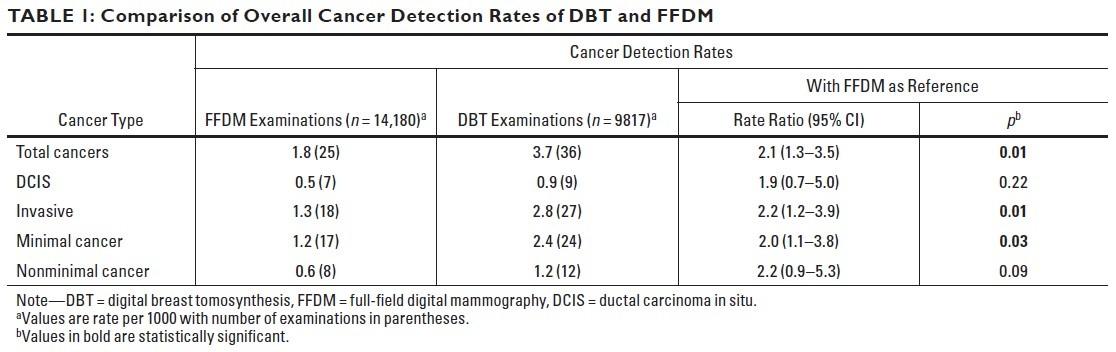
Where CDR were not statistically significant for DBT and FFDM, Dang noted, “We were likely underpowered to show a significant difference because of the smaller number of cancers in these subgroups. For instance, CDR of moderately and poorly differentiated invasive cancers, and for all cancer sizes detected with DBT, was nearly twice that of FFDM, even though it was not statistically significant.”
As Dang concluded, “our results suggest that integrating DBT into clinical practice may detect overall more cancers than does FFDM, for all tumor sub-types, grades, sizes and nodal statuses.”
For more information: www.ajronline.org
Reference
1. Dang P.A., Wang A., Senapati G.M., et al. Comparing Tumor Characteristics and Rates of Breast Cancers Detected by Screening Digital Breast Tomosynthesis and Full-Field Digital Mammography. American Journal of Roentgenology, published online Oct. 15, 2019. DOI: 10.2214/AJR.18.21060

 April 20, 2026


